
A china 3pl consolidation service receives goods from your suppliers, checks them in, and merges them into one shipment so you pay for one outbound load instead of many. Doing it yourself means leasing space, hiring staff and running receiving on your own. The right call depends on volume, frequency and how much control you want.
What a 3PL consolidation service handles
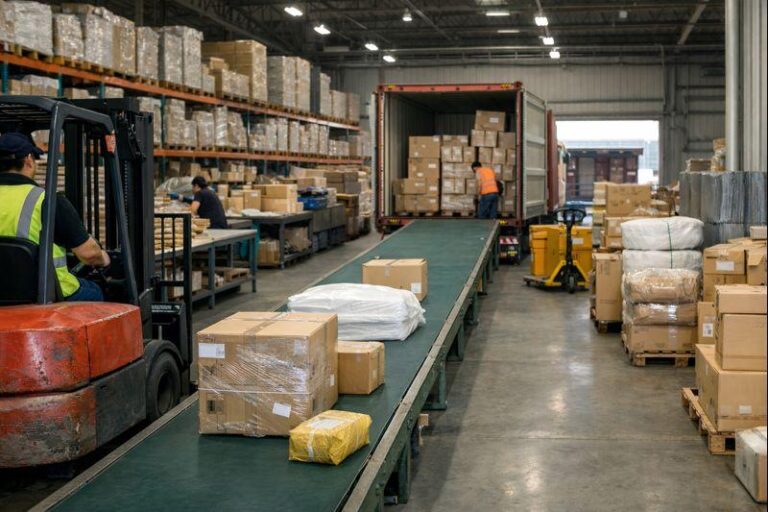
A consolidation 3PL (often a Guangzhou-based warehouse) runs receiving, counting, SKU matching, short-term storage and the final merge before freight booking. You send each supplier’s cartons to one address and a multiple-supplier consolidation flow handles the rest. This is the model most small and mid-size sellers use because it needs no lease or local team.
What self-run consolidation requires
Running it yourself means leasing warehouse space, hiring receivers, setting up a way to track stock, and building freight relationships. You keep full control and see every carton, but you also carry the fixed cost whether or not goods arrive that month.
Visible cost comparison
| Cost line | 3PL consolidation | Self-run |
|---|---|---|
| Space | Pay per use | Monthly lease |
| Labor | Included in handling fee | Salaries and training |
| Freight | Booked for you | You book directly |
| Scaling | Flexible per volume | Fixed capacity |
Hidden costs often missed
Self-run looks cheaper on paper until idle months, staff turnover, peak-season capacity crunches and capital tied up in a lease show up. A 3PL spreads those risks across many clients, so your cost tracks volume instead of a fixed commitment.
Which seller profile fits which model
- Irregular or growing volume: 3PL keeps cost variable.
- Steady, high volume near one city: self-run can pay back.
- Mixed or seasonal: a hybrid (3PL plus a small buffer) is common.
A decision matrix
Score yourself on three axes: monthly inbound volume, number of active SKUs, and how much hands-on control you need. Low volume plus many SKUs points to a 3PL. High steady volume plus tight control points to self-run. Most sellers landing in the middle do best with a warehousing and consolidation 3PL and a clear service agreement.
Frequently Asked Questions
Is a China 3PL consolidation service cheaper than self-run
For irregular or growing volume, usually yes, because you pay per use instead of carrying a lease and staff. At very high steady volume near one city, self-run can become cheaper, but hidden costs like idle capacity often narrow the gap.
At what volume does self-run consolidation make sense
There is no fixed threshold, but self-run tends to pay back only when space stays consistently full and you already manage local labor. Below that, a 3PL keeps cost variable and avoids idle lease risk.
Can a 3PL handle quality checks during consolidation
Many do. Receiving often includes a count and visual check, and some offer deeper inspection as an add-on. Confirm the exact check scope in the service agreement so expectations match.
What do I lose by outsourcing consolidation
You give up day-to-day hands-on control and direct sight of every carton. In return you remove lease, labor and scaling risk. A good agreement and clear reporting close most of the visibility gap.
Can I switch from self-run to a 3PL later
Yes. The move is common when volume becomes uneven or peaks outgrow fixed space. Plan a handoff window so in-flight supplier cartons are not interrupted.