
Short answer (put this in the first screen, above the fold)
FBA prep is now your responsibility, not Amazon’s. In 2026, third-party prep in China typically costs $0.15–$0.60 per unit for standard labelling and bagging. By contrast, US prep centres usually charge $1.25–$2.50 per unit before you add inbound freight and receiving fees to move the goods there.
The per-unit rate is only the smallest part of your decision. On the same 2,000 units, the gap between a $700 invoice and a $2,400 invoice almost always comes down to receiving fees, materials, storage, and the freight you pay to ship unprepared stock to a prep centre.
| Arbeitsposten | Typical China (origin) rate | Typical US prep-centre rate |
|---|---|---|
| FNSKU labelling | {{YOUR_NUMBER}} / unit (market: $0.15–$0.35) | $0.30–$0.50 / unit |
| Polybag + suffocation warning | {{YOUR_NUMBER}} / unit (market: $0.25–$0.60) | $0.50–$1.50 / unit |
| Bubble wrap / fragile protection | {{YOUR_NUMBER}} / unit | $0.50–$1.00 / unit |
| Bundling / multi-pack (per set) | {{YOUR_NUMBER}} / set | $1.00–$3.00 / set |
| Carton packing + box label | {{YOUR_NUMBER}} / carton | $1.00–$3.00 / carton |
| Empfang | {{INCLUDE_OR_CHARGE}} | $25–$75 / pallet |
| Lagerung | {{YOUR_RATE}} | $0.80–$1.20 / cu ft / month |
| Inbound freight to the prep centre | not applicable — goods are already there | $500–$2,000+ / container |
Market ranges are compiled from published 2026 rate cards held by third-party prep providers and logistics publishers. They are reference points, not quotes.
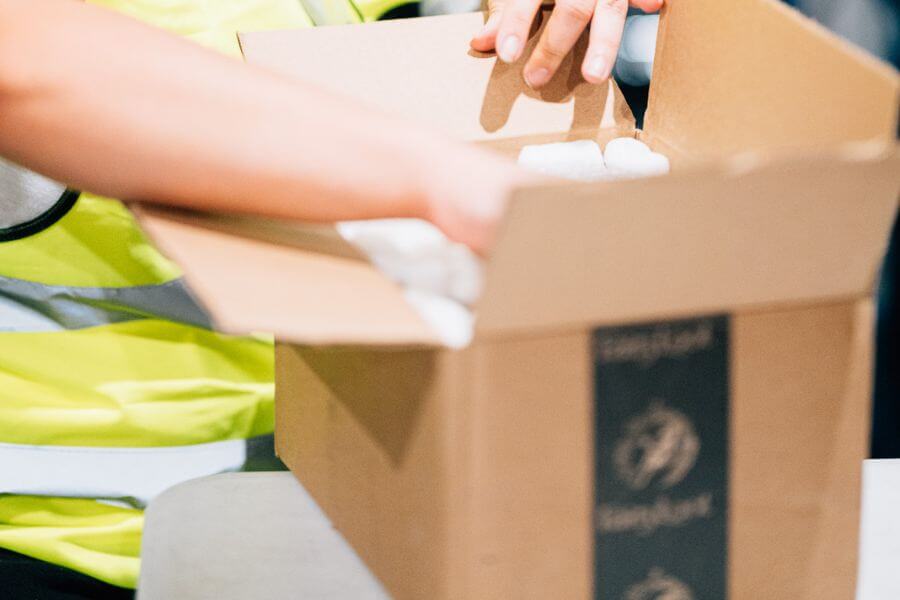
What “FBA prep” covers since 1 January 2026
Amazon stopped offering in-warehouse prep and item-labelling for shipments created on or after 1 January 2026 in the US store. (The same change reached European and Canadian stores on 1 July 2026.) Sellers who used the service before paid about $0.55 per unit for labelling.
That service is gone, so every unit must now reach the fulfilment centre already:
- FNSKU-labelled — scannable, covering the manufacturer barcode completely, applied flat on a smooth surface
- Polybagged where required — transparent, sealed, with a printed suffocation warning for the destination marketplace
- Protected — fragile items wrapped before packing, not after a claim
- Bundled correctly — one sellable set, one FNSKU, no exposed component barcodes
- Cartonised to the shipment plan — correct box weights, 200 lb / team-lift / mech-lift thresholds respected, box IDs matching the plan
Two consequences change the cost maths. First, someone has to do the work — the only question is whether it happens in China before the crossing or in the destination country after it. Second, a non-compliant carton is now a receiving problem, not a fixable fee. Rejected stock must be retrieved, re-prepped, and re-shipped, usually at a higher total cost than proper origin prep.
The five charges that make a “cheap” prep quote expensive
Ask about these before you compare per-unit rates, because each one is where a low headline price gets recovered later.
Which minimums apply, and when? A monthly minimum, a minimum order size, a minimum storage charge — ask specifically what you pay in a month where you ship nothing.
Is the label included, or just the application? “Labelled at $0.12/unit” often means you supply the labels and you pay for the rolls. Ask whether label stock is included and what happens when a label file changes mid-shipment.
Are polybags included, or charged per bag? Bagging quotes sometimes exclude the bag itself and the suffocation-warning print. On a 5,000-unit run that gap becomes a real number.
What counts as a “unit”? Per sellable unit, per component in a bundle, or per carton? For a 4-pack sold as one ASIN, a per-component price is four times a per-set price — and this single ambiguity explains most quote disputes.
Is receiving a separate line? Some providers charge per pallet und per carton und per SKU for counting. Free receiving is common at origin, because supplier deliveries arrive on a pallet either way.
Worked example: 2,000 units, FNSKU + polybag
| Prepare in China | Prepare in the US | |
|---|---|---|
| Ocean freight, unprepared goods to a US prep centre | — | ~$300 (share of a container) |
| US receiving (palletised) | — | ~$150 |
| Prep labour | 2,000 × {{YOUR_ALLIN_RATE}} | 2,000 × $1.00 |
| Bag + label materials | {{INCLUDED_OR_NOT}} | often separate |
| Storage while waiting | {{YOUR_RATE}} | $100–$250 |
| Domestic freight, prep centre Amazon | — | $300–$800 |
| Indicative total | {{YOUR_TOTAL}} | ~$2,500–$3,500 |
The China-side number is lower for a boring reason: the goods are already where the work happens. Every extra handoff adds a freight leg and a receiving fee, not just labour.
The honest caveat: this only works if the prep is done properly. A China prep error costs more than a US prep error, because you find out about it one ocean later. That is what the inspection record and photo evidence in a quote are actually for.
How to cut the per-unit cost without cutting compliance
- Send larger batches. Nearly every provider tiers per-unit pricing; the step from 500 to 5,000 units is far larger than the step from 500 to 500.
- Don’t pay for protection your product doesn’t need. A retail-ready boxed item usually needs no polybag and no bubble wrap. Ask what is required rather than accepting a bundle.
- Fix your supplier’s packaging once. If cartons arrive pre-sized and units already in individual bags, the prep bill falls permanently. This is a negotiation with the factory, not with the prep centre.
- Consolidate suppliers before prep, not after. Two suppliers mean two inbound freight bills and two receiving events — unless someone combines them first.
- Standardise label files. A mid-shipment label change triggers relabelling, carton rebuilding, and re-checking, and all three get billed.
What a transparent China prep quote should contain
If your quote does not answer these, it is not comparable with another quote:
- Charging unit for each work item (unit / set / carton / order / handling step)
- Which materials are included and which are billed
- What the receiving check actually covers (count? visual? functional? photos?)
- How exceptions are handled and who authorises extra work
- Storage basis and the date it starts
- What outbound handling includes, and what the carrier or destination is billed separately for
- Any minimum charge, and what happens in a zero-shipment month
We publish our quote structure — without rates — on the pricing and quote scope page, because the second you compare two providers on rate alone you are comparing two different scopes of work.
Häufig gestellte Fragen
How much does FBA prep cost per unit in China?
Published 2026 market rates for origin prep run roughly $0.15–$0.60 per unit depending on whether the work is labelling only or labelling plus bagging and inspection. Bundles and fragile items price higher. Your actual number depends on SKU count, quantities and material inclusion.
Is prep in China cheaper than a US prep centre?
Per unit, usually yes — but the real difference is the extra freight leg and receiving fee a US centre adds, because unprepared goods have to be shipped to it first. On multi-thousand-unit shipments the gap is commonly several hundred to a few thousand dollars.
Did Amazon stop doing FBA prep?
Yes. As of 1 January 2026 Amazon no longer offers in-warehouse prep or item-labelling for shipments created on or after that date. Every unit must arrive ready for stow, or the shipment risks rejection at receiving.
What does FNSKU labelling cost?
In the range of $0.15–$0.35 per unit at China origin according to publicly listed 2026 rate cards, and $0.30–$0.50 at US prep centres. Confirm whether the label stock itself is included.
Does a bundle cost more to prep?
Yes, and usually by more than the extra materials suggest, because it adds assembly, a completeness check, and one FNSKU applied to the outer pack with no component barcode left visible. Ask for a per-finished-set price, not a per-component price.